Categories
Policy Papers

The Changing Face of Foreign Exchange

The last few years have been turbulent times for all those involved in the financial markets as they come to terms with all the changes in regulation, market behaviour and market practice. In the past, buy-side institutions such as institutional investors, pension funds, asset managers, wealth managers and private banks have tended to be immune from any turmoil. This time is completely different as the changes are more far-reaching and the upheaval is having a significant impact on all financial market participants, but it has come as a particularly major shock to the fund management industry.

Clearly there has been an increase in costs as a result of compliance with the new risk and regulatory regime. Frequently, additional resources are required to meet the extra administrative burdens associated with doing business in the current environment. Undoubtedly these do not fall fairly across the spectrum of institutions involved and become a barrier to entry for new specialist entrants.

One way institutional investors and asset managers can turn this new business environment to their advantage is in the area of FX. These new regulatory changes are a unique opportunity to upgrade their business model, their FX operational processes and improve efficiency to reduce investment costs and improve fund performance.

Categories
Press Releases

The Changing Face of Foreign Exchange: Hidden Cost or Undiscovered Treasure?

In an opinion paper published today, IIMI looks at the current challenges and opportunities that confront institutional investors from the increased regulatory scrutiny of foreign exchange, and how these can bring direct business benefits. The full paper is available here.

FX is a necessary part of any asset management business that invests internationally and the costs associated with pricing FX transactions are often unclear or unknown. The paper attempts to quantify the extent and significance of this problem by reviewing the size and the mechanics of the global FX market and the European fund industry.

The paper also reviews the impact of recent and future regulation such as MiFID II, which is regarded as a positive influence, particularly in areas such as best market practice and transparency. The paper explores the positive benefits these could bring to institutional investors and asset managers and focuses on some of the immediate actions needed to improve the FX investment processes.

Commenting on the role of foreign exchange within asset management, Toby Illingworth, Executive Director of IIMI, said: “The pursuit of FX transparency and best market practice will deliver direct benefits to Institutional investors, most of which only use FX as an integral and necessary transaction in their investment process. It is estimated that mispricing of FX transactions comes at a cost of at least EUR1.5bn a year to the European fund industry, so by eliminating this there is an automatic and immediate uplift in fund performance and, ultimately, fee income and profitability. Clients will in turn receive a higher return on their assets and an improvement in the quality of service through better transparency and market practice.”

He continued: “These new regulatory changes are a unique opportunity for asset managers to upgrade their business model, their FX operational processes and improve efficiency to reduce investment costs and improve fund performance. That can only be good for building strong business relationships.”
A summary of the paper and its recommendations to both regulators and asset managers is provided below.

Summary

  • Mispriced FX transactions cost the European fund industry and their underlying clients EUR1.5 billion per year, on a conservative basis.
  • A conservative estimate shows that $590 billion of FX transactions related to institutional investments is at risk of being mispriced on a daily basis.
  • Recent events demonstrate there is a potential to misprice client FX transactions. It is clearly the responsibility of institutional investors and asset managers to ensure they receive the best FX pricing and best execution from their banks, at all times.
  • The London 4.00pm FIX carries too much influence and is a flawed method of execution. The interests of banks and clients are conflicted.
  • Market activity around the FIX is irrational and generates a spike in volatility resulting in an increase in market spreads. Trading FX at the London 4.00pm FIX is predominantly one directional skewing market pricing and adding a false premium to market pricing.

Recommendations

  • Regulators should communicate clearly and in a cohesive manner any new regulations and directives to the market using local associations and trade bodies as points of contact for follow up seminars and workshops.
  • Regulators should not operate a “One size fits all” methodology to impose new regulation. Differentiate requirements as to size and type of activity and use a gradual implementation process. Start with systemic risk institutions and move through the spectrum.
  • Regulators should clearly state and stick to their timelines helping to avoid confusion.
  • Investors and asset managers must review internal trading strategies and practices to comply with regulatory requirements, business objectives and best market practice.
  • Investors and asset managers should use MiFID II to improve transparency and clarity in their FX process, specifically the trading strategy and market practice with banks. Create a competitive advantage by demonstrating to clients their best interests are being protected.
  • There is an urgent need for institutional investors and asset managers to use independent FX transaction cost analysis (TCA) in their investment process. Use TCA data to make informed decisions to improve trading strategies and practices and reduce trading costs and efficiencies.
  • Investors and asset managers should access and utilise consultants with FX market expertise, experience and knowledge to maximise the benefit of new technology and trading venues.

ENDS

Categories
Policy Papers

The Next Five Years: Regulatory Challenges That Will Impact Asset Managers

The New City Initiative was established to both promulgate our vision for better alignment between investors and money managers – but also to give positive steer to regulators and governments as to how to achieve this. This paper outlines clearly the issues confronting our industry over the coming years and where we would either draw our members’ attention to certain issues, or where we think the regulatory framework could be better structured. Wellington talked about ‘The Other Side of The Hill’ and I hope this document gives some clue as to what is in store for our firms in the near and medium term.

What we find, time and time again is that regulations designed to do one thing (make for a ‘safer world’) actually end up doing the exact opposite – normally destroying competition, making the larger firms larger and thus potentially reducing returns to investors, customer retention, and making the whole system more delicate. The powers that be have oftenmisunderstood what ‘risk’ is and how it is up to a market to price it properly. Much of their efforts to somehow ‘control’ risk, either force it into dark corners where it cannot be easily seen or reduce liquidity in a market, where the real and ultimate risk (as seen in 2008) is a liquidity crisis. We continue to argue that better structures and culture lead to better outcomes and we remain committed to the path of less regulation and more forcing of a change in how people ‘think and operate’ to achieve these same goals of managing risks and being more transparent.

Our view is to promote positive change and I hope that you will find in this paper not only a new set of worries but also a set of quite simple answers to help us make for a better environment in financial services.

Dominic Johnson

Chairman, New City Initiative
CEO and Founding Partner of Somerset Capital Management LLP

Categories
History Policy Papers

Asset management in Europe: The case for reform

The key trade-off for any business is that of costs versus income. The issues surrounding regulation are very similar – businesses need to operate in a regulated market, but the benefits of regulation need to outweigh the costs. This premise is very relevant for the European Union project. The free trade zone initially created by the European Economic Community (EEC) and the efficiencies (supposedly) generated by a single currency, all should lead to an increase in trade, benefitting all concerned.

However, the investment management community and especially the ‘boutique’ (i.e. smaller firms) community find that the regulatory burden imposed upon us by the EU (AIFMD, MiFID II, etc.) is so expensive and onerous, that in themselves these regulations are an issue in terms of our business sector prospering. We also find that the implied benefits of an open and free trade zone are largely illusory. As companies trying to sell our products across Europe, we are constantly obstructed by an uneven application of the law, ignorance of the free trade rules, and in some cases protectionism. In this paper, this is clearly illustrated in our case studies of accessing Germany and Slovenia. The costs of the regulations in many instances outweigh the advantages.

This is a serious situation to find ourselves in, and in collaboration with Open Europe we wanted to bring a positive case for reform in Europe at a time when both the economic and political basis of the principal of Europe are coming under increasing pressure. We have laid out in this paper a clear series of changes we would like to see made, as well as illustrated the barriers we currently experience to a ‘proper’ free trade zone in Europe. We have specifically avoided trying to make political judgements, leaving that for the politicians, but we do believe that bigger, freer trade zones, properly regulated, are highly desirable for all members of the New City Initiative and we hope that our thoughts here help us achieve this goal.

Dominic Johnson

Chairman, New City Initiative
CEO and Founding Partner of Somerset Capital Management LLP

Categories
History Policy Papers

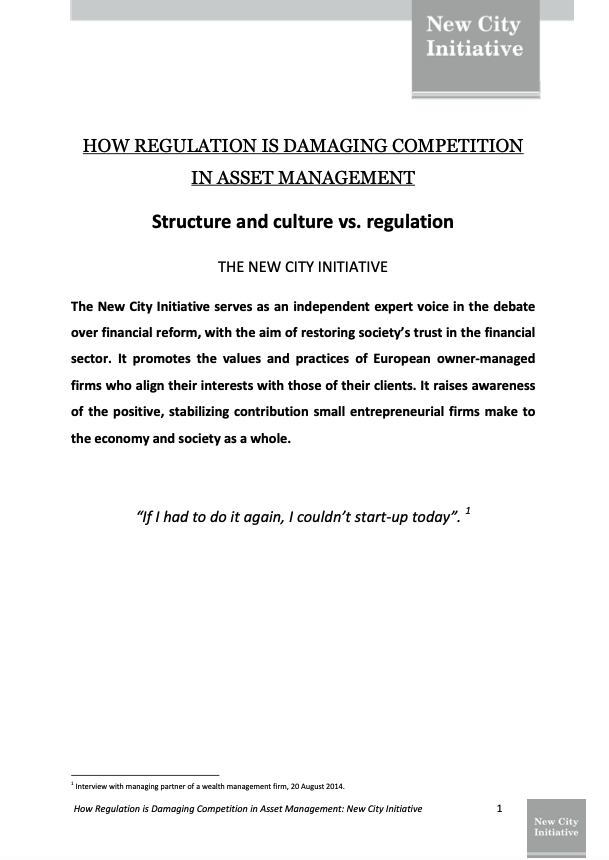
How Regulation is Damaging Competition in Asset Management

  1. The UK SME asset management sector has traditionally been vibrant and strongly growing, but it is now stagnating, as new start-ups cannot support the financial cost resulting from increasing regulation.
  2. Boutique asset and wealth management firms find the burden of regulatory compliance increasingly onerous.
  3. New financial regulations from the EU and UK are applied equally to the very biggest and smallest asset management firms, disregarding their ability to shoulder the consequent financial and legal burdens.
  4. If financial regulation is not imposed more proportionately on large and small asset management firms, the NCI is convinced that many fewer start-up firms will come to market. This arrest of competition will damage all, but especially the consumer, as choice will become much more limited.
  5. The legal complexity of and the potential financial punishment for infringements of regulation pose massive obstacles to the growth of competition in this sector.
  6. A new ‘priesthood’ – compliance officers – has emerged from the financial crash. As the regulatory regime becomes ever-complex and continually evolves, and the scale of potential punishments so damaging to small firms, the temptation is for compliance officers to engage in ‘gold-plating’ to avoid any possibility of failure to comply.
Categories
Submission

Dominic Johnson – Money: Master or Servant? – St Paul’s Institute

Dominic Johnson is one of three speakers who bring their theological, academic and practitioner perspectives to explore the ways in which we relate to money. How has the role and importance of money changed in recent years, is it now an idol, and have we become slaves to it?

Speakers:

The Rt Revd Dr Peter Selby – Former Bishop of Worcester and Author.

Dominic Johnson – Chair of New City Initiative and CEO, Somerset Capital Management.

Ben Dyson – Founder of Positive Money. Chaired by Barbara Ridpath, Director of St Paul’s Institute.

This event was recorded at St Paul’s Cathedral, London on 28th October 2014.

Categories
History Press Releases

Dominic Johnson appointed as Chairman

IIMI, the independent City think tank pushing for cultural change in the Square Mile and beyond, announces the appointment of Dominic Johnson as Chairman, effective 1st July 2014. Mr Johnson replaces Magnus Spence, after a successful period at the helm.

Founded in 2010, the IIMI speaks for owner-managed firms concerned with the interests of clients and investors, and aims to restore public faith in the asset management sector.

Commenting on Mr Johnson’s appointment, Executive Director Gary Mead said: “Dominic has been a prolific and outspoken member of the IIMI since he helped set it up with Daniel Pinto in 2010, fighting against overzealous legislation from Europe and for a cultural revolution to align the interests of fund managers and their clients.”

Mr Johnson added: “I look forward to leading the charge towards better structures and a sounder culture in finance, helping small firms bloom, and working with other members of this unique organisation to achieve our collective goals.”

Mr Johnson, previously Deputy Chairman, is also CEO and Founding Partner of Somerset Capital Management LLP, the employee-owned $5.3bn Global Emerging Markets specialist fund management firm.

Dominic has spent the last 19 years raising capital for various institutions in Asia, the USA and the UK, starting with Robert Flemings in London in 1995 and Jardine Fleming in 1998. From 2001-2007 Dominic, with Jacob Rees-Mogg and Edward Robertson, built Lloyd George Management from $1.5bn under management to $16bn when he left in April 2007 to establish Somerset Capital.

ENDS

Categories
Submission

Submission: Banking Standards Review

Categories
Submission

House of Lords Economic Affairs Finance Bill Sub-Committee – Oral Evidence on Partnership tax alterations

Categories
History Press Releases

Magnus Spence appointed as Chairman

IIMI, the London and Paris based think tank, has appointed Magnus Spence as Chairman. He replaces Daniel Pinto who has stepped down after completing his three year term in the role.

Spence, who takes up the position with immediate effect, is CEO of City based investment manager Dalton Strategic Partnership (DSP), a business he founded in April 2002 following seven years at Merrill Lynch Investment Managers/Mercury Asset Management. He has been on the Board of IIMI since May 2010.

“It is with great pleasure that we announce Magnus’s appointment as Chairman of the NCI. An active member of the Board since May 2010, he has already played an important role in the organisation’s success to date and was the obvious choice to take over from Daniel who has successfully led the NCI since its creation.”

Derek Laud, Executive Director of IIMI

“IIMI is a unique organisation both in terms of its make-up and influence within the financial services sector. Under Daniel’s leadership and direction, the NCI has already demonstrated it has a valuable role to play in helping rebuild trust in the sector and it is a great honour to be taking over from him as Chairman.”

Magnus Spence, incoming Chairman of IIMI

ENDS