Categories
Policy Papers

The significance of the SME sector in the UK Financial Services industry

The SME sector remains a vital component of the UK financial services sector employing over 350,000 people.

Based on analysis using IMAS-insight, IMAS estimates that the SME sector employs over 350,000 people across a range of organisation sizes including 50-250 employees (c. 30%) and 10-50 employees (c. 15%).

The estimate is based on data from the FSA Register for FSA Approved Persons where employee data is not available, as well as statistical averages where no company employee or Approved Person data is publically available.

The SME financial services sector in asset management has demonstrated strong resilience through the downturn

Within the asset management sector (fund managers and private client wealth managers), the SME sector has consistently grown its share of employment of FSA Approved Persons since 2007 to over 45% of the market.

In addition, the SME sector has shown greater resilience through the downturn compared to the Large Cap sector. The SME sector demonstrated both higher growth than the Large Cap sector in 2008 & 2009 as well as a lower contraction than Large Cap in 2010.

The SME sector has grown female employment of FSA Approved Persons in the downturn against falls in the Large Cap sector

In the 2007 to 2009 period, the SME sector grew female FSA Approved Persons by 16%, compared to falls of 5% in the Large Cap sector.

This has also enabled the SME sector to steadily grow its female mix of FSA Approved Persons from 13.4% in 2007 to 13.8% in 2009.

Categories
Policy Papers

Alignment of interests: Fixing a broken city

The NCI brings together a group of privately-owned wealth and fund managers that have a track record of driving innovation and high standards in this key section of the country’s financial landscape. Collectively, this group manages approximately £150 billion and employs several thousand staff. We form part of the essential bridge between savers and investors on one hand and, on the other, the many wealth and employment creating companies that are dependent on external investment for their success.

Our focus is naturally on highlighting our collective experience of what works in our own industry sector, what will ensure its continued success, and what will harm it, but we believe the same principles and lessons will also have relevance to other types of City institution, to which we are bound by our many overlapping interests and a shared reputation.

A central part of our function is the management of financial risk on behalf of clients. Risk is an inherent factor in the investment process, and it is risk that helps bring about the efficient allocation of the nation’s capital to the most productive and wealth-generating companies and activities. This provides benefits to both government and society as a whole. However while risk-taking in its many forms is the engine of economic growth, to be a force for good it must be managed appropriately, professionally and ethically.

The recent financial crisis has led to renewed focus on curbing what many have regarded as excessive risk-taking in specific areas by financial managers. The reputation of the City has been damaged by recent events, and its governance and actions are under unprecedented scrutiny. We aim to become an active participant in the resulting discussions over the coming months.

Regulation has an essential role of course, and we welcome and benefit from appropriate and effective regulation. However members of the NCI do not believe that the prescriptive drift in the current reform debate will impact effectively upon excessive risk taking.

Therefore above and beyond reviews of regulation we believe that there is a need to address the culture and guiding principles by which financial services companies operate. In other words, the starting point for tackling perceived excess should be the reinvigoration of some basic principles of good governance.

We focus here on one core principle, the desirability of ‘alignment of interest’ between market participants. This is a tool which can limit the likelihood of making bad investment decisions which harm individual savers and the financial system in general.

Categories
Submission

Submission; FSA’s proposed revisions to the Remuneration Code under CRD3

Categories
History

Daniel Pinto founder and Chairman

Daniel Pinto, Founder and Chief Executive of Stanhope Capital Group launches the New City Initiative and becomes its first Chairman.

Categories
History

New City Initiative launches

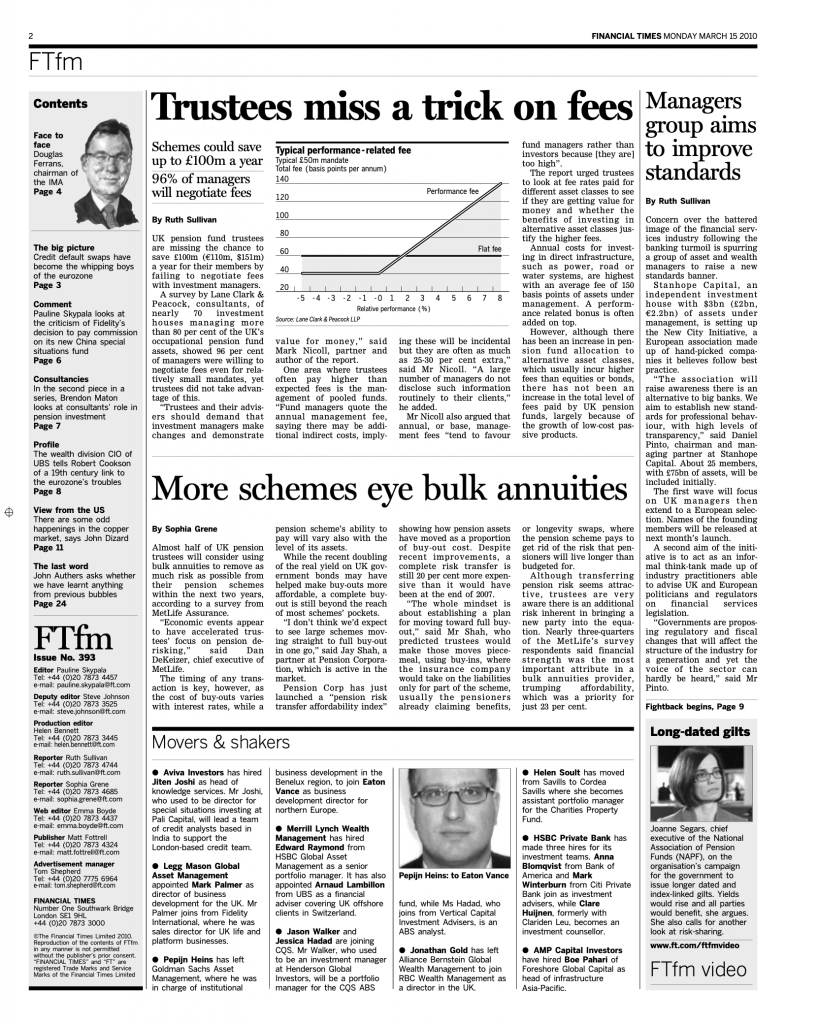
From the Financial Times, 15 March 2010:

Concern over the battered image of the financial services industry following the banking turmoil is spurring a group of asset and wealth managers to raise a new standards banner.

Stanhope Capital, an independent investment house with $3bn (£2bn, €2.2bn) of assets under management, is setting up the New City Initiative, a European association made up of hand-picked companies it believes follow best practice.

“The association will raise awareness there is an alternative to big banks. We aim to establish new standards for professional behaviour, with high levels of transparency,” said Daniel Pinto, chairman and managing partner at Stanhope Capital. About 25 members, with £75bn of assets, will be included initially.

The first wave will focus on UK managers then extend to a European selection. Names of the founding members will be released at next month’s launch.

A second aim of the initiative is to act as an informal think-tank made up of industry practitioners able to advise UK and European politicians and regulators on financial services legislation.

“Governments are proposing regulatory and fiscal changes that will affect the structure of the industry for a generation and yet the voice of the sector can hardly be heard,” said Mr Pinto.