Categories
Member Update

Fund managers brace themselves for Russian fall-out

Despite the glaring warning signs and litany of pessimistic Western intelligence reports, the Russian invasion of Ukraine caught a number of institutional investors by surprise. According to data from the Moscow Exchange (MOEX), foreign investors are currently sitting on circa $86 billion of Russian equities, $20 billion of Russia’s USD debt and  $41 billion of Rouble denominated sovereign bonds. [1] 

A number of institutional investors – including pension schemes and sovereign wealth funds across the US, UK, Canada, Norway and Australia – are coming under massive political and regulatory pressure to divest their Russian holdings. Several Russian-focused funds have already suspended investor redemptions. Given the extent of the sanctions being imposed on Russia –  offloading these problem assets will be incredibly tough. Capital losses are also expected to be substantial owing to the precipitous fall in market prices, doubling of Russian interest rates and collapse of the Rouble’s value.

So what is exactly happening? The exclusion of certain Russian banks from the SWIFT financial messaging network at the end of February had already made it extremely complicated for foreign institutions to exit their Russian investments. In short, this measure effectively rendered it almost impossible for firms to remit any sales proceeds from Russia. Not only are foreign investors at enormous risk of breaching sanctions rules if they do sell their Russian assets, but few – if any counterparties – will want to buy or sell Russian securities because of the political environment, market risk and potential scope for incurring harsh penalties should they violate sanctions.

Compounding matters further is that foreign institutions are banned by the Russian government from selling locally listed securities on MOEX while trading of Russian companies abroad has been suspended. According to the FT-  Nasdaq, Deutsche Borse and the London Stock Exchange (LSE) are among some of the major stock exchanges to have introduced share trading bans on listed Russian securities.[2] In addition, the LSE has ceased trading of global depository receipts of several Russian-based companies including Rosneft, Sberbank, Gazprom, En+ and LuKoil.  Elsewhere, MSCI and FTSE Russell have both excluded Russian securities from their respective EM (emerging markets) indices – a decision that will further heap pressure on the country’s embattled equity market.

At a financial market infrastructure level, CSDs (central securities depositories) have also made it significantly harder for foreign institutions to trade in the Russian market. Euroclear confirmed it would suspend its link with the Russian Bank, VTB, which until now has acted as the main outlet for trades in Russian securities for both Euroclear and Clearstream. Clearstream also stated that the Rouble was no longer an eligible settlement currency inside or outside of Russia, while Euroclear stopped settling Rouble denominated trades transacted outside of Russia on March 3. [3] Asset servicing has also been impacted with income distributions accrued from Russian securities now suspended until further notice. It is unclear what would happen if a Russian security undertook a corporate event but it should be assumed overseas investors impacted by the embargo would have to allow it to lapse.

With there being no end in sight to this crisis, it is highly probable that foreign institutions’ holdings of Russian assets are likely to be trapped for the foreseeable future. Local providers in Russia – such as custodians – can certainly provide information to clients, –  but other services will likely be restricted.


[1] Financial Times (March 1, 2022) Investors struggle to trade Russian assets as sanctions hit market plumbing

[2] Financial Times (March 1, 2022) Investors struggle to trade Russian assets as sanctions hit market plumbing

[3] Reuters (February 28, 2022) Europe carves out Russian securities from financial markets
Categories
Member Update

Market data faces a regulatory reckoning

The cost of market data being supplied by benchmarks and indices to asset managers – together with the complexity of the contracts binding investment firms to these providers – is an issue that IIMI (Independent Investment Management Initiative) has repeatedly raised with regulators  – most notably the UK’s Financial Conduct Authority (FCA). In a missive released in January, the FCA confirmed that it will launch two studies investigating how easily market participants can access wholesale data. 

According to the FCA, this comes amid mounting concerns that there is limited competition in the markets for benchmarks and indices, credit ratings and trading data, which in turn is leading to higher costs for fund managers and their end investors. The FCA said the first study – which will start in the Summer – will review concerns that contracts for benchmarks and indices are excessively complex – in what is precluding investment firms from switching to cheaper, better alternatives. At the end of the year, the FCA continued it would launch a follow-up study examining whether high charges for access to credit rating data is creating added costs for investors and hindering new market entrants.

The FCA said it will be gathering input about competition in the market for wholesale trading data, namely information about what financial instruments are being traded; how much people are prepared to pay for them, and the prices at which transactions are executed. A lot of this information is supplied by trading venues – principally stock exchanges – where the transactions take place. Nonetheless, there is disquiet about the absence of proper competition in this corner of the market, in what some say is resulting in asset managers facing higher costs. Others point out these costs might even have an impact on the nature and type of assets that investment managers buy and sell.

One IIMI manager adds that the lack of clarity over display and non-display data contracts with wholesale data providers and exchanges is still a live issue. This is because many managers are being challenged on how they use security/index data in their trading activities. Some firms have been informed by providers that these activities are not covered by their existing contracts or are being forced to sign new contracts to cover data use for something they did not need to pay for previously.

Experts say this FCA review could pit stock exchanges  – where proceeds from data distribution and sales are becoming an increasingly important component of their revenues – against asset managers, who are frustrated about the rising data charges – especially at a time when margin pressures elsewhere continue to grow. A number of investment firms are spending more than ever on operations – including data –  despite facing fee compression and heightened regulations. In response, many managers are looking to net meaningful cost savings, something which could be facilitated through greater competition in the benchmarking world.

As the UK increasingly strives to attract more foreign investment into the country post-Brexit, greater competition in terms of how market data is supplied could be one of the ways in which this is achieved. 

Categories
Member Update

Regulations to Watch 2022

The regulatory tsunami shows no sign of relenting anytime soon.  The Independent Investment Management Initiative(IIMI) looks at some of the regulations, which could affect its members in 2022.

  1. ESG – no let up yet

The introduction of new ESG rules in both the EU and UK will have an impact on some IIMI members’ operations. Although the EU has delayed the SFDR’s (Sustainable Finance Disclosure Regulation’s) Level 2 obligations until January 2023, managers should be thinking about their next steps in terms of compliance. Under the Level 2 rules, asset managers will need to report on 18 compulsory PAIS (Principle Adverse Impacts) in addition to a number of voluntary disclosures covering sustainability. Elsewhere, the UK is adopting its own provisions around ESG having published its “Roadmap to Sustainable Investing” report at the tail-end of last year. The UK’s report outlined plans to subject asset managers to ESG disclosure requirements and pledged to establish a taxonomy  – with the latter likely to have some overlap with the EU’s benchmark. Nonetheless, it is clear that different countries will impose their own ESG rules in what is likely to fuel further arbitrage and cause confusion.

  • Phase six of UMR (uncleared margining rules) takes effect

Having introduced phases one through to five of EMIR’s (European Market Infrastructure Regulation) initial margining rules for uncleared OTC derivatives, Phase 6 will be felt by a much greater number of buy-side firms including UCITS and AIFMs. Firstly, the final phase will apply to financial institutions with an AANA (average aggregate notional amount) in excess of €8 billion. According to ISDA (International Swaps and Derivatives Association), around 775 firms will be affected by Phase 6, which is more than double that of Phase 5, and will most likely include a number of boutique asset managers. Affected managers must ensure they have processes in place to facilitate the posting of initial margin.

  • CSDR – settlement efficiency is now paramount

Although EU regulators have confirmed that mandatory buy-in requirements under the CSDR (Central Securities Depositories Regulation) have been postponed (potentially by several years), cash penalties for settlement fails will apply from February 2022. Most asset managers have historically presumed that it is their custodians or brokers who are primarily responsible for ensuring trades settle on a timely basis. Not anymore. Under CSDR, CSDs (central securities depositories) will be entrusted with imposing fines for settlement fails on brokers and custodians, who unless they are themselves at fault – will offload these costs to underlying clients responsible for the fails, namely asset managers. As such, managers need to augment their settlement processes if they are to avoid CSDR cash penalties.

  • AIFMD – not the overhaul many expected

Many of the proposed amendments by the EC to AIFMD have been welcomed by the industry. It was widely feared that non-EU asset managers would find their access to EU investors heavily restricted were AIFMD’s delegation requirements to be tightened up, but this has not happened. Instead, the delegation rules remain largely unchanged much to the industry’s relief. It is true the National Private Placement Regime (NPPR) rules have been toughened up but only marginally so. Right now, non-EU AIFMs and AIFs using NPPR cannot be based in countries designated by the Financial Action Task Force as being a non-cooperative country or territory. The EC has since said that third country AIFs cannot market into the EU if they are based in a country on the EU’s list of non -cooperative jurisdictions for tax purposes and AML.  While this will not apply to high-profile financial hubs like the UK or US, it could impact some offshore centres – with the Cayman Islands having been on such a list as recently as 2020. In a worst-case scenario, restrictions could be imposed on managers running offshore funds in certain domiciles.

Categories
Member Update

AIFMD – amendments now under discussion

A month ago, the European Commission (EC) announced far-reaching proposals designed to curtail non-EU banks – including those based in the UK and Switzerland – from cross-selling their services into the Single Market. With an EC review of the AIFMD (Alternative Investment Fund Managers Directive) also looming, a number of UK asset managers were bracing themselves for the worst, namely the imposition of new limits further impeding their ability to access EU investors.  In November, the EC finally published its proposed amendments to AIFMD – which are more measured than what many had anticipated.

Let’s begin with the good news. Despite a lot of noise emanating from certain member states about banning the practice entirely – delegation is likely to continue albeit subject to a few additional requirements. The EC has said that delegation by AIFMs and UCITs of portfolio management and risk management to third countries will not change, but managers must have substance in the EU. In effect, the EC has stated that AIFMs and UCITS need to employ at least two full-time EU residents so as to prevent the emergence of letterbox entities. A number of law firms have stressed that this provision is not especially burdensome and simply codifies existing rules.

However, “whilst there is no requirement for an AIFM to retain more risk or portfolio management than is delegated, there are more onerous reporting requirements where this is the case. The proposal is that competent authorities notify the European Securities and Markets Authority (ESMA) on an annual basis of delegation arrangements where more risk or portfolio management is delegated to third-country entities than is retained,” according to an article by law firm Dechert. ESMA will also assess how member states are applying the delegation rules and will conduct regular peer reviews to ensure letterbox entities are not being created and regulatory arbitrage is avoided.

Revisions to the AIFMD’s National Private Placement Regime (NPPR) – while not laborious or prohibitive – could potentially pose problems for some alternative asset managers –  if political circumstances were to dramatically change. Right now, non-EU AIFMs and non-EU AIFs looking to leverage NPPRs cannot be based in a jurisdiction designated as being a “non-cooperative country or territory” by the Financial Action Task Force (FATF). Moving forward, the EC is now widening the goals posts and proposing that third country AIFs cannot be distributed into the EU if they are operating out of a market that is on the EU’s list of non-cooperative jurisdictions for tax purposes and AML (anti-money laundering) – i.e. a high-risk third country.

While this clause is unlikely to affect non-EU AIFMs in leading financial centres such as the UK, US, Hong Kong, Singapore or Switzerland, offshore fund hubs (i.e. the British Virgin Islands, Cayman Islands, Jersey, Guernsey) could find themselves under scrutiny. Although none of these offshore centres are currently deemed high risk by the EU from an AML or tax perspective, the Cayman Islands was on the EU Tax List between February 2020 and October 2020.  If one (or more) of these offshore centres were to be added to an EU AML or Tax List, then it could prevent managers with funds domiciled in those jurisdictions from marketing into the EU. 

The EC’s proposed revisions are not ground-breaking nor are they likely to disrupt IIMI members’ operations. Barring a few added requirements here and there, the EC’s amendments will come as a relief to  IIMI  members who had previously assumed that much tougher rules would be introduced.

Categories
Member Update

Managing Cloud Risk

A few years ago, regulators – including the UK’s Financial Conduct Authority [FCA] scrutinised asset managers’ outsourcing arrangements, highlighting repeatedly that improvements were necessitated – especially around their contingency plans for a service provider failure. Although asset managers have since implemented more robust systems and backup procedures to properly insulate themselves against the failure of a critical third-party, concerns are mounting that the industry is missing some glaring risks-namely around cloud service providers [CSPs].

CSPs are used by a wide array of financial institutions – including banks and asset managers. To their proponents, CSPs are an effective way for asset managers to reduce their IT costs, realise economies of scale and increase operational resilience – the latter being a massive selling point in a post-COVID-19 world. At a time when margins are shrinking, CSPs can provide efficiencies at asset managers enabling firms to redeploy more internal resources to revenue-generating and client-facing activities. While CSPs confer many benefits for fund managers, they are not without risks, something which regulators such as  ESMA[European Securities and Markets Authority]are becoming more attuned to.

So what are the main issues around CSPs? Research shows that three providers – Amazon World Service, Google and Microsoft – control 60% of the CSP market suggesting very high levels of concentration risk. An outage or failure at one or more of these CSPs could pose huge operational and technological challenges for their underlying clients. ESMA warns “migrating to the cloud….can also raise challenges at the firm level in terms of governance, data protection and information security. Operational risks are also relevant as they result from inadequacies or failures of internal processes, people, and systems, or from external events, and they may impact financial institutions in different ways. For instance, data losses could happen due to failures, deletion or disasters that occur at CSPs, or when CSPs outsource some of their functions to third parties, or ‘fourth parties’. Cyber risk is also important to consider, as massive amounts of data are stored in cloud ecosystems. ‘Vendor lock-in’ is also relevant when financial institutions rely strongly on the services of one CSP,” reads ESMA’s report.

While COVID-19 has reinforced the importance of technology, it has also simultaneously illustrated how vulnerable the financial services industry is too disruptive events of all stripes – including technology outages. The European Commission, in particular, has started to pay more attention to digital resiliency, namely IT risk management, incident reporting and IT third party risk with the publication of DORA [the Proposal for a Regulation on digital operational resilience for the financial sector]. This is something asset managers will need to be cognisant of. It is not just regulators who are examining asset managers’ CSP and third party IT arrangements, but so too are institutional investors. It is vital asset managers can demonstrate they have an excellent understanding of IT and CSP risk.

Categories
Member Update

Divergences start to show on Brexit

In the run-up to Brexit last year, many within the industry lobbied the UK government extensively arguing for a bonfire of EU regulations –  as they applied to financial services. While a sweeping away of EU rules never materialised, the UK has gradually been diverging away from the EU on some regulations.

Take ESG [environment, social, governance] as an example. Although the EU introduced its Sustainable Finance Disclosure Regulation [SFDR] and is in the process of developing a Taxonomy to provide investors with a benchmark outlining what economic activities are sustainable, the UK is unlikely to onshore either of these provisions. Instead, the UK is demanding asset managers running at least £5 billion produce ESG disclosures which are based on the Financial Stability Board’s [FSB] Task Force for Climate-related Financial Disclosures [TCFD]. Some lawyers have argued the UK’s approach is incredibly sensible, pointing out the TCFD is a global, pre-existing standard, in contrast to the EU’s Taxonomy, which is being manufactured from scratch. This means more global institutions are likely to have adopted the TCFD standard, unlike the EU’s taxonomy, which is expected to be far more euro-centric.  However, the dual regulatory approach does risk creating challenges for investment firms with operations straddling both the UK and EU.

The Central Securities Depositories Regulation [CSDR] is another piece of regulation on which the UK has deviated from the EU. Although many investment firms assume CSDR is applicable to post-trade providers only, the rules will be felt widely, including within asset management. Under the CSDR’s Settlement Discipline Regime [SDR], counterparties to failed trades will be subject to cash penalties and mandatory buy-ins. While the industry begrudgingly accepts that the threat of cash penalties will help drive up settlement discipline, mandatory buy-ins could prove destabilising, by creating added costs and undermining liquidity. The European Securities and Markets Authority [ESMA] has recognised this and is advising the European Commission to delay the phase-in of mandatory buy-ins beyond their current implementation date of February 2022. Some industry associations have warned the EU that CSDR’s buy-in rules could have catastrophic implications during periods of extreme volatility, highlighting that systemic events might have occurred [especially in the bond markets] had the rules been in place during March/April 2020. While there is speculation the EU could make buy-ins voluntary, the UK already confirmed that the SDR will not apply in the domestic market, in a move that has been largely welcomed by the industry. Nonetheless, UK managers will still need to comply with SDR for any European transactions which are settled by EU-based central securities depositories.

Beyond ESG and settlement discipline, the UK is also making tweaks to other EU rules. It recently acknowledged that non-financial counterparties [NFCs] do not need to report under the Securities Financing Transaction Regulation [SFTR]. Similarly, it is believed that the UK’s Financial Conduct Authority [FCA] could ease some of the research rules and best execution obligations imposed under the Markets in Financial Instruments Directive II (MiFID II). Proposals have emerged suggesting the UK could exempt SMEs with a market cap of less than £200m together with FICC [fixed income, currencies, commodities] research from MIFID II unbundling requirements. Elsewhere, MiFID II  share trading obligations and double volume caps have also been shelved by the UK regulators. These revisions to EU regulations are receiving a positive response from the industry.

Although the UK is shifting away from a handful of EU rules, the differences are not massive and certainly do not represent a race to the bottom. Instead, the UK appears to be taking a proportionate and sensible approach to post-Brexit rulemaking, at least for now.

Categories
Member Update

The UK pursues a home-grown ESG regime

Investor appetite for ESG (environment, social, governance)-focussed and sustainable funds is reaching new heights, fuelled by the sector’s perceived performance benefits; regulatory intervention; and growing fears about stranded asset risk. According to Morningstar data, ESG funds accumulated $139.2 billion in net inflows during the second quarter of 2021, bringing total AuM (assets under management) to $2.3 trillion. [1] Amid the asset class’ strong growth, regulators – particularly in the UK- are keen to ensure standards remain high – following growing concerns about potential greenwashing.

Improving clarity around ESG funds

In a letter to AFMs – published in July 2021 – the UK’s Financial Conduct Authority [FCA] noted that it had seen a notable increase in ESG/sustainable funds applying for authorisation, before adding that a number of these applications “have been poorly drafted and have fallen below our [FCA] expectations.” In its letter, the FCA continued that many of the ESG claims in these applications do not bear scrutiny, and stressed they should have been addressed during the fund product design process. Among some of the more egregious examples of product mis-labelling cited by the FCA included a proposed passive fund with an ESG-related name which was looking to track an index that was not ESG-focused. In another case,the FCA criticised  a sustainable investment fund  for having two high carbon emitting energy companies in its portfolio holdings without “providing obvious context or rationale behind it – e.g. a stewardship approach that supports companies moving towards an orderly transaction to net zero.” Such behaviour risks undermining consumer confidence in ESG funds.

In response, the FCA has outlined a set of guiding principles on the design, delivery and disclosure of ESG and sustainable funds. These requirements are entirely sensible and proportionate, and have not elicited criticism from the Independent Investment Management Initiative [IIMI]. For example, the FCA urges that references to ESG in a fund’s name, financial promotions or any other documentation should reflect the materiality of ESG/sustainability considerations to the objectives and/or investment policy and strategy of the fund. For example, the FCA highlights managers should not use terms such as ‘ESG’, ‘ethical’ or ‘green’ in their fund name unless they are directly adopting such strategies. The second principle states that the resources used by a firm to pursue its ESG objectives be appropriate, and the manner in which an investment strategy is implemented be consistent with its disclosed objectives. And finally, the third principle advises that pre-contractual and ongoing periodic disclosure by sustainable investment funds be available to consumers and must contain information to help them make investment decisions. The latter requirement will be vital in ensuring trust among retail clients.

Enhancing ESG reporting in the UK

Having announced in November 2020 that it would introduce climate-related disclosure obligations for asset managers, life insurers and pension providers, the FCA has since published a consultation – CP21/17 – outlining its requirements. Under the FCA’s proposals, in-scope investment firms [i.e. UK AIFMs; UK UCITS] will need to produce disclosures which are based on the Financial Stability Board’s [FSB] recommendations  in the Task Force on Climate-related Financial Disclosures [TCFD]. The FCA has said the new reporting requirements will take effect from January 1, 2022 for the largest investment managers, namely firms with more than £50 billion.  As of January 1, 2023, the rules will apply to all other fund managers running at least £5 billion in AuM. Although the proposals only cover UK managers, an article by international law firm Sidley Austin warns that non-UK managers could also be indirectly impacted. “The FCA’s proposals could result in in-scope UK asset managers and asset owners requesting that a non-UK asset manager provide certain product-level information – in order to discharge the in-scope UK asset managers’/asset owners’ own disclosure obligations,” it continues.[2]

In terms of the specific reporting obligations, the FCA has told managers to report information at both an entity and product/portfolio level. In the case of entity level disclosures, “these would be made with reference to activities over the previous 12 months using the most up to date information available. We {FCA] are proposing to give firms the flexibility to select the 12-month reporting period for their first entity level TCFD report provided that the period begins no earlier than January 1, 2022 and that the first disclosures are published on their website by June 30, 2023.”[3] On product and portfolio level disclosures, the FCA said “firms required to make public disclosures would be required to publish them on their websites by June 30 of each calendar year. These disclosures would be made using the most up-to-date data available at the time of reporting. The data must be calculated within the 12 month reporting period covered by the TCFD entity report. Firms would be required to publish disclosures on their website by June 30. This includes [or cross-reference to] the website disclosures in the appropriate client communication which follows most closely after the reporting deadline. In the case of on demand disclosures to institutional clients, firms must provide the requested information from July 1, 2023.” Although it is clear the UK needs to demonstrate its ESG credentials – particularly following Brexit – there are concerns among managers about the risk of duplication of ESG regulations.

ESG reporting could pose challenges

In isolation, the UK’s climate reporting regime appears sensible, not least because it adopts a widely used international standard [TCFD] as its template. Nonetheless, the UK’s approach does create its own problems, especially for firms who are also caught out by the EU’s SFDR (Sustainable Finance Disclosure Regulation). With more regulators across the globe now contemplating their own bespoke ESG reporting regimes (i.e. the US and certain APAC markets), there is a risk that the entire process could become increasingly complicated and costly. This comes at a time when boutique investment managers are already grappling with rising regulatory costs and operational overheads – the latter a direct consequence of the pandemic. While the IIMI fully supports a comprehensive and meaningful ESG reporting regime, it has growing concerns that too many regulators are introducing their own rules in silos leading to duplication and arbitrage. Moreover, the multitude of different reporting templates and approaches that are likely to emerge is going to be confusing for investors, particularly retail.  In order to mitigate this risk, it is vital  regulators engage and collaborate with each other when developing their ESG reporting regimes , so that there is a degree of standardisation and consistency.  


[1] Reuters (July 27, 2021) Global sustainable fund assets hit record $2.3 trillion in Q2, says Morningstar

[2] Sidley Austin

[3] FCA

Categories
Member Update

An ESG Update

Having implemented the first phase of the Sustainable Finance Disclosure Regulation [SFDR] in March – a set of provisions which requires asset managers to publish detailed information about how ESG (environment, social, governance) criteria are incorporated into their decision-making processes –  the EU has since confirmed that the second phase of the regulation will be delayed by a further six months until July 2022. The Phase 2 requirements relate to rules surrounding content, methodologies and presentation of the sustainability disclosures which managers must now provide to their EU investors.

This comes as the European Commission [EC] seemingly conceded a delay was necessary to ensure the seamless implementation of the rules. It noted in a letter that the length and technical detail of the RTS [Regulatory Technical Standards]; late submissions to the EC and the likelihood of further amendments had also contributed to the postponement. The decision to push back the rules, however, has been welcomed across the industry. With the EU’s Taxonomy Rules also coming into force in January 2022, many argued that introducing the Level 2 SFDR measures simultaneously – as was originally planned – risked creating too much work for asset managers.

Some lawyers argued that the delay will give fund managers more time to prepare their SFDR templates resulting in better and more transparent disclosures. In an article, Pinsent Masons said the delayed introduction of the Level 2 measures was in part an acknowledgement of the rushed and piecemeal implementation of the Level 1 SFDR requirements, which obliged managers to implement the rules even though the Level 2 provisions were not in place.

The UK takes its own position on ESG

However, the UK has chosen not to onshore the SFDR’s provisions and is instead pursuing its own ESG regime. Under proposals recently published by the Financial Conduct Authority (FCA), UK asset managers will be required to align their climate-related disclosure procedures with the recommendations outlined by the Financial Stability Board’s (FSB) Task Force on Climate-Related Financial Disclosures (TCFD). The rules will apply to all managers with more than £5 billion in AUM (assets under management) from January 2023, with the first reports expected to be submitted by June 2024.

An ESG maze

The multitude of different ESG regulations being introduced is creating problems for asset managers. It is not just the UK and EU who are adopting their own ESG regulations, but so too are a number of markets in Asia (i.e. Hong Kong, Singapore) and potentially even the US under its new administration. With this patchwork approach to ESG rulemaking, asset managers could find themselves being forced to comply with a wide variety of competing or even contradictory regulations. These risks adding to their compliance costs at a time when margins are under enormous pressure. If ESG is to truly thrive, then regulators need to adopt a more uniform and standardised approach towards its implementation.

Categories
Member Update

Getting back into the office: Boutiques lead the way

Despite the stop-start nature of lockdown restrictions together with all of the uncertainty over the last 18 months, financial institutions – including asset managers – are busily assessing the logistics of bringing their staff back into the office once again.  This process, however, will not be straightforward  – while a number of ethical issues remain unanswered. The Independent Investment Management Initiative (IIMA) – formerly known as the New City Initiative [NCI] – conducted a survey of its diverse membership – in which it asked them about their preparations for returning to the office.

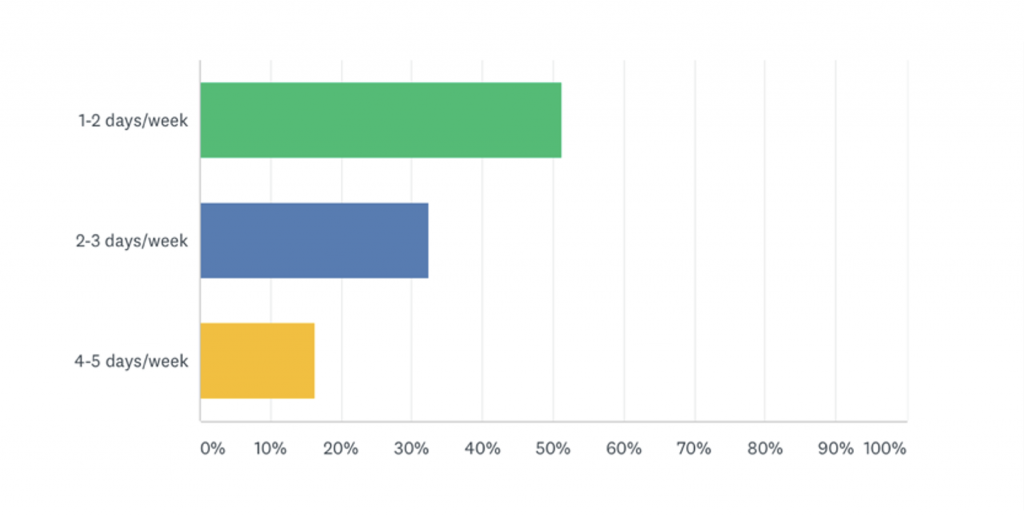
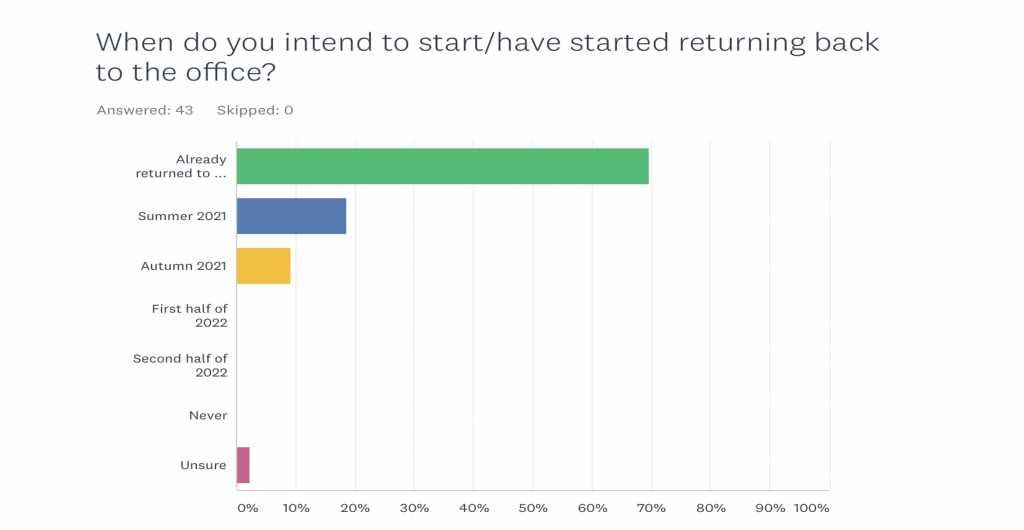
 69.7% of respondents to the survey said they had already returned to the office, while a further 18% intend to do so during Summer, and 10% by Autumn. Many boutique firms are currently requiring their employees to come into the office on a rotational basis. The overwhelming majority (76.7%) of IIMI members said that they planned to adopt a flexible working approach while 11.6% confirmed they would not. Of the firms which said they would adopt flexible working, just over half [51.3%] plan to let their employees work from home 1-2 days per week. A further 32.4% said they would allow staff to work from home 2-3 days/week, while 16.2% of members are open to letting employees work from home 4-5 days/week.

Of the firms who are reticent about introducing flexible working, 28% cited productivity concerns as the primary reason for being sceptical, whereas a further 28% warned it could have an adverse impact on training. This comes amid growing concern among senior leadership that staff training and the ability to innovate are not as conducive when performed behind a webcam or through intermittent attendance in the office.

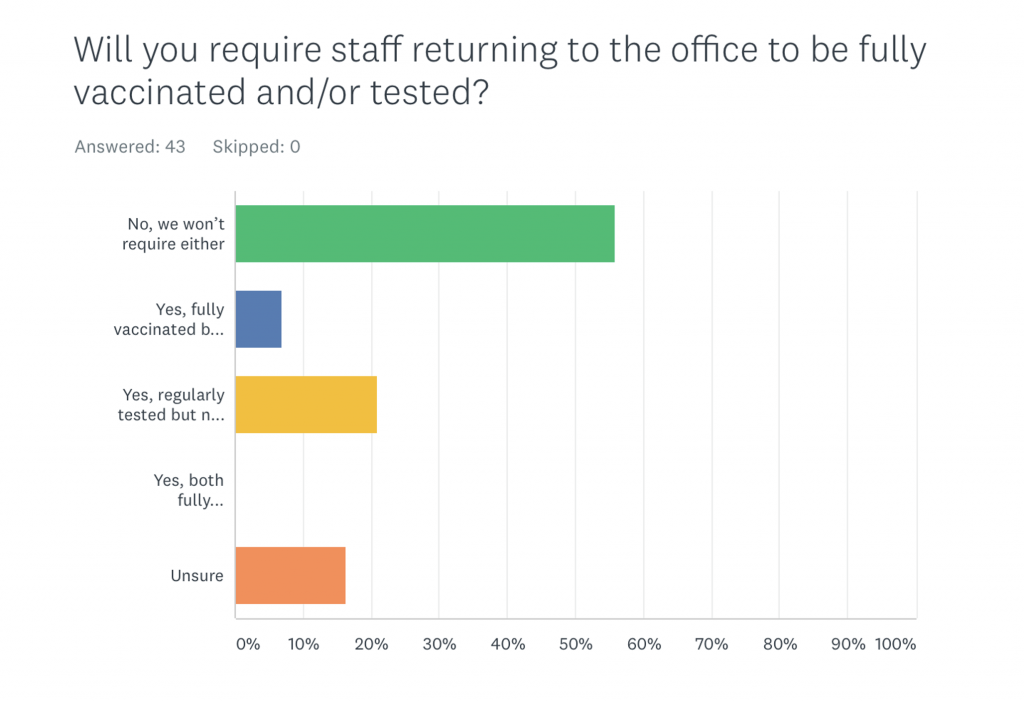
This is prompting a handful of large organisations to take a forceful line on returning to the office. Employers recognise this carries risk, which has led to some organisations demanding that only staff who have been fully vaccinated can return to the office. This is the policy among several high profile US financial institutions – including Morgan Stanley – which recently announced that only staff or clients who have been vaccinated can enter its New York office. A similar policy was adopted by BlackRock. Meanwhile, Goldman Sachs recently said staff must confirm their vaccination status although the bank added that unvaccinated staff could still come into the office but they must socially distance and wear masks. Interestingly, 55.8% of IIMI members said they would not make it mandatory for staff to be either tested and/or vaccinated. 20.3% of respondents said staff must be regularly tested but not necessarily vaccinated. 6.98% of IIMI members will insist that employees be regularly tested and fully vaccinated although 16.2% said they are unsure.

Of those firms which will not require staff to be fully vaccinated or regularly tested, 27.2% said indirect discrimination risk was an issue,  while 22.7% said such a policy would pose serious ethical concerns. “We are a small team where we expect everyone to take collective responsibility . We provide the ability for all staff to undertake testing regularly and encourage it, but we do not mandate it,” said one member.

IIMI will be conducting qualitative interviews with its membership about their post-COVID-19 working practices in the next few weeks. The findings of this more detailed paper will be published in the early Autumn.

Categories
Member Update

Expect Scrutiny of Outsourcing Post-COVID-19

For many asset managers – including members of the Independent Investment Management Initiative (IIMI) – outsourcing has been a fantastic enabler, allowing firms to net meaningful operational savings and transition away from a fixed to a more variable costing structure. With returns so volatile and margins being eroded away by rising management fee compression, an intelligent and thoughtful outsourcing strategy can be a huge value-add. Nonetheless, the pandemic has exposed some serious deficiencies in the conventional outsourcing approach, which urgently need addressing.

Outsourcing has been an area of focus for the Financial Conduct Authority (FCA) for a long time. Nine years ago, the FCA’s predecessor – the Financial Services Authority – admonished asset managers for being too reliant on their outsourcing partners, warning that a failure by a service provider could result in serious operational disruption at their businesses. Since then, improvements have been made although in 2020 the FCA issued a note – published before the seriousness of COVID-19 became so obvious – warning asset managers that they had inadequate governance; oversight; risk management and clear contractual arrangements with their outsourced providers. The FCA continued that it expected fund managers to have in place processes to deal with outages and wind downs. It also urged managers to keep an eye on concentration risk, and the impact this could have on business continuity.

COVID-19 will be a case study in business continuity for many years to come. During COVID-19, a number of problems emerged with managers’ outsourcing arrangements. There were those firms who externalised a lot of their operational activities albeit to a number of different providers. While sound from a counterparty risk perspective, it can have drawbacks. Just as too many cooks in the kitchen can spoil the broth, an abundance of outsourced providers creates an additional layer of operational complexity, increasing the scope for errors or mistakes, especially during a fast moving pandemic situation. At the other end of the spectrum,  some service providers are encouraging managers to consolidate their outsourcing relationships. While it is economical and easier to have processes like administration, custody, depositary, collateral management, FX and prime brokerage being carried out by a single entity, it is a major counterparty risk , and one that could elicit scrutiny from institutional investors, especially those who have the Lehman Bros’ default etched in their memories. A balanced, sensible approach towards outsourcing therefore needs to be adopted by asset managers.

Outsourcing practices have also been found wanting by events in India. At the beginning of the pandemic – when India implemented one of the world’s most draconian lockdowns – a number of outsourcing providers were caught off guard. With a number of staff working in back office roles prohibited from going into work, providers were forced to dispatch laptops, mobiles and even install home Broadband networks to ensure that processes such as NAV calculations and trade reconciliations were not disrupted. Barring a few glitches, the industry weathered the initial storm successfully. A year later and with India suffering a catastrophic second wave, disruption to back office operational activities caused by staff sickness is an issue many providers are having to confront. In response, asset managers need to scrutinise their own providers’ outsourcing arrangements, and ascertain that they too have contingency plans in place to weather the ongoing COVID-19 disruption.

It is highly likely that institutional investors and regulators will conduct a thorough review of asset managers’ outsourcing arrangements and business continuity processes. As a result, investment firms will need to think very carefully about how they outsource core operational activities moving forward.